Categories
Production scheduler

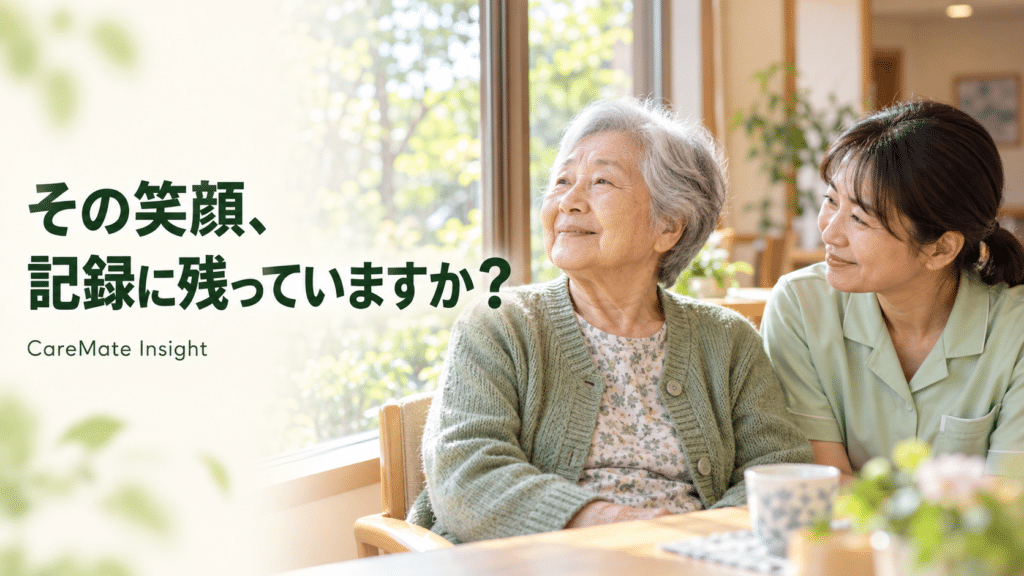
Nothing Happened Today—or Did We Simply Forget?

Nothing Happened Today—or Did We Simply Forget?

We should not look at residents merely to complete a care record. We should record the insights that come from truly seeing them.

I have worked in three care facilities in Funabashi, Japan, and I am now working at a fourth. Most of my experience has been in group homes, along with some work in small-scale multifunctional care.

I participate in frontline care almost like a part-time member of staff. Yet this experience has taught me more than any meeting or report could. Some problems can only be seen by standing beside residents and caregivers in the course of an ordinary day.

Reconstructing an entire day at 5 p.m.

One evening, shortly after 5 p.m., I saw a day-shift caregiver writing records with a pen. When I asked what they were writing, they were trying to remember what each resident had done that morning and whether they had joined the afternoon recreation.

The resulting entries were things such as, “Watched television in the morning” and “Participated in recreation in the afternoon.” For some residents, there was nothing specific to write, so the record simply said, “No change from usual.”

But did nothing really happen in that person’s day?

There may have been a change in expression, a quiet remark, a different response at mealtime, a small interaction with another resident, or a reaction to a caregiver’s words. Many meaningful moments can occur between morning and evening.

It is not that nothing happened. By the end of the shift, the small moments could no longer be remembered. This is not a failure of individual caregivers. It is a limitation of a system that asks one person to reconstruct an entire day after the fact.

When responsibility for records pulls us away from observation

In many care settings, responsibility for documentation is assigned by shift. At my current workplace, the day-shift caregiver is mainly responsible for writing the daily records.

This naturally directs attention toward facts that can fill the record: the resident attended day care, joined an activity, watched television, or returned to their room. But it may leave out what matters most: What was their expression? What was different today? What did they say? How did they respond?

Because I am not the designated record writer, I am less concerned with finding something to put in a box. I find myself watching residents more naturally—and sometimes noticing more than the person assigned to write the record.

Instead of asking the record writer to observe,
let the person who observed create the record.

Many caregivers and managers may recognize this contradiction once it is put into words. It is not about blaming anyone. Long-established roles and documentation routines have gradually separated observation from recording.

The moment “It hurts” was not the usual “It hurts”

One 104-year-old resident often said, “It hurts,” when staff touched or moved her during transfers. Over time, the phrase had come to be regarded as her usual complaint.

One day, however, she was sitting in her wheelchair and saying, “It hurts,” even though nobody was touching her. A day-shift caregiver and I were both nearby. The other caregiver interpreted it as the same familiar complaint.

I felt that something was different precisely because nobody was touching her. When we checked her in bed, her abdomen was distended. She had not had a bowel movement for four days, and impacted stool was visible. After appropriate toileting assistance, her complaint of pain subsided.

The words were the same, but the circumstances were different. Once someone is labelled as “a person who always says it hurts,” an important physical signal can be dismissed as routine.

CareMate Insight does not diagnose illness. Its purpose is to help staff notice when a familiar word appears in an unfamiliar situation, capture that observation immediately, and share it with the team.

Capture the moment without interrupting care

I use CareMate Insight myself while working. With an iPhone in my hand, I can record a resident’s expression, words, or small change by voice or with a few short phrases at the moment I notice it—even while moving through the facility.

In a nine-resident group home, I can aim to capture ten observations per person—90 observations in a day—without placing a heavy burden on the work. There is no need to return to a desk, and the recording process barely interrupts care.

The goal is not to impose a quota of 90 entries. The important point is that when recording is easy and immediate, many observations accumulate naturally.

  • Anyone on the early, day, late, or night shift can record what they notice.
  • Staff can use a short phrase or voice input instead of composing formal prose.
  • AI can organize those observations into clear, readable language.
  • Accumulated insights can support team communication and meaningful family updates.

Because a group home is a person’s home

For many residents, a group home becomes the place where they will live for the rest of their lives. That is why I want each day to hold as much dignity, meaning, and human connection as possible.

Instead of ending with “There was no change today,” I want us to be able to say, “This was the expression we saw,” or “These were the words we heard.” I want the record to show that this person truly lived this particular day.

CareMate Insight is not simply a way to digitize care records. It is a way to keep small human observations from disappearing—and to turn them into better care.

See the resident not as a subject to document,
but as a person to understand.

I could only recognize these problems because I continue to work on the frontline. Caregivers and managers may already sense them, even if they have never had the opportunity to put them into words.

Take another look at your daily records. Do they preserve only where a resident went and what activity they completed—or do they also preserve the person’s expressions, words, and individuality?

Turn small insights into better care

Learn more about the philosophy, features, and implementation of CareMate Insight on our global website.

Discover CareMate Insight

We also welcome inquiries about implementation and staff guidance.
Categories
Production scheduler

その人の一日には、何もなかったのではない。後から思い出せなかっただけです。

その人の一日には、何もなかったのではない。
後から思い出せなかっただけです。

介護記録を書くために利用者を見るのではありません。利用者を見て生まれた気づきを、記録として残すのです。

私はこれまで、船橋市内の3つの介護施設で働き、現在は4つ目の施設で介護の現場に入っています。グループホームを中心に、小規模多機能型居宅介護の現場にも関わってきました。

本業のかたわら、アルバイトのような立場で現場に参加しています。しかし、この経験がCareMate Insightを考えるうえで、何にも代えがたい学びになっています。会議室や資料の中だけでは、決して見えないことがあるからです。

夕方になって、一日を思い出して書く

ある日の夕方5時過ぎ、日勤職員がボールペンで介護記録を書いていました。「何を書いているのですか」と聞くと、午前中に何をしていたか、午後のレクリエーションに参加していたかを思い出しながら書いていました。

記録に残るのは、「午前中はテレビを見ていた」「午後はレクリエーションに参加した」といった内容です。中には、特に書くことが見つからず、「いつもと変わりなし」とされる利用者もいます。

本当に、その人の一日には何もなかったのでしょうか。

表情の変化、何気ない一言、食事のときの様子、ほかの利用者との関わり、職員の声かけへの反応。朝から夕方までの間には、小さな出来事がいくつもあったはずです。

何もなかったのではありません。夕方になってから一日を振り返っても、小さな出来事まで思い出すことができなかったのです。これは職員個人の努力不足ではなく、後からまとめて書く記録の仕組みに限界があるのだと思います。

記録担当者ほど、観察から離れてしまう

介護現場では、記録を書く役割が勤務帯によって決められていることがあります。現在の職場では、早番・日勤・遅番・夜勤のうち、主に日勤者が記録を書きます。

すると日勤者は、「デイに参加した」「レクリエーションをした」「居室へ移動した」といった、記録欄を埋めるための事実を気にするようになります。その一方で、どのような表情だったか、いつもと何が違ったかという、その人自身の様子が残らなくなることがあります。

私は記録担当ではないため、「何を書かなければならないか」に縛られず、自然に利用者を見ています。その結果、記録担当者よりも多くの変化に気づくことがあります。

記録する人が観察するのではなく、
観察した人が記録できる仕組みへ。

これは、少し立ち止まって考えれば、多くの介護職員や管理者が「確かにそうかもしれない」と感じることではないでしょうか。誰かが悪いのではありません。長く続いてきた役割分担と記録方法が、いつの間にか観察と記録を切り離してしまったのです。

「いつもの痛い」で終わらせなかったこと

104歳の女性利用者がいました。移乗などで身体に触れると、普段から「痛い、痛い」と訴えることがあり、職員の間では「いつもの訴え」として受け止められていました。

ところがある日、車椅子に座り、誰も身体に触れていないのに「痛い」と訴えていました。すぐ近くには私と日勤職員がいましたが、日勤職員は「いつも痛いと言っているから」と、特別な変化としては受け止めませんでした。

私は、誰も触れていないのに痛がっていることを「いつもと違う」と感じました。ベッドで確認すると、お腹が張り、4日間排便がなく、肛門から便が見えていました。排便の介助を行うと、その後、痛みの訴えは治まりました。

同じ「痛い」という言葉でも、そのときの状況はいつもと違っていました。「この人はいつも痛いと言う」という思い込みがあれば、大切な身体のシグナルを見過ごしてしまいます。

CareMate Insightが行うのは、病気の診断ではありません。「いつもと同じ言葉」の中にある「いつもと違う状況」に気づき、それをその場で残して、職員同士で共有することです。

介護を止めず、その瞬間に残す

私自身、勤務中にiPhoneを片手にCareMate Insightを使っています。歩きながらでも、利用者の表情や会話、小さな変化に気づいた瞬間、音声や短い言葉で入力できます。

9名の利用者について、一人10件、合計90件の気づきを残すことを目標にしても、実際にやってみると大きな負担ではありません。記録のために机へ戻る必要がなく、介護の仕事をほとんど邪魔しないからです。

大切なのは、90件という数字をノルマにすることではありません。その場で簡単に残せるため、結果として多くの気づきが集まるということです。

  • 早番・日勤・遅番・夜勤の誰でも、気づいたときに残せる
  • 立派な文章を書こうとせず、短い言葉や音声で入力できる
  • AIが内容を読みやすい文章に整える
  • 集まった気づきを、職員間の共有や家族への報告につなげられる

グループホームは、その人の暮らす場所だから

グループホームは、多くの利用者にとって人生の最後まで暮らす場所になります。だから私は、一日一日を少しでも充実したものにしたいと思っています。

「今日もいつもと変わりありませんでした」で終わらせるのではなく、「今日はこんな表情がありました」「こんな言葉が聞かれました」と、その人が確かに過ごした一日を残したい。

CareMate Insightは、単に介護記録をデジタル化するためのアプリではありません。現場にある小さな気づきを埋もれさせず、より良い介護へつなげるための仕組みです。

利用者を記録の対象として見るのではなく、
一人の人として見つめる。

私が現場に入り続けているからこそ、見えてきた問題があります。そして同じ現場で働く職員や管理者の方であれば、この問題にきっと心当たりがあると思います。

一度、日々の記録を冷静に見直してみてください。そこには、その人の行動だけでなく、その人の表情や言葉、その人らしさが残っているでしょうか。

小さな気づきを、より良い介護へ

CareMate Insightの考え方、機能、導入方法については、公式ページでご案内しています。

CareMate Insightを詳しく見る

導入や使い方についてのご相談も承ります。

Categories
Production scheduler

Don’t Dismiss It as “The Usual”—CareMate Insight Begins

Don’t Dismiss It as “The Usual”—CareMate Insight Begins

Every day, countless small changes occur in eldercare settings.

“She ate a little less than usual today.”

“His expression seemed slightly tense.”

“She looked uncertain when she stood up.”

“He said something different from what he normally says.”

Each change may appear small.

In a busy care environment, it is easy to respond in the moment and then move on. Yet these small changes may contain an early sign of discomfort, declining health, fall risk, or an unmet need.

A 104-Year-Old Woman and a Different Kind of “Pain”

One 104-year-old resident frequently said, “It hurts,” while staff members were helping her transfer.

Over time, her words were understandably treated as part of her usual pattern.

Then, one day, she said, “It hurts,” while sitting in her wheelchair, even though nobody was touching or moving her.

Something was different.

A closer check revealed that she had not had a bowel movement for four days and that a large stool had become lodged near the opening. After she received appropriate assistance, her pain soon settled.

If her words had simply been dismissed as “the usual,” this important change might have been missed.

What made the difference was not an advanced test or a large collection of numerical data.

“Something is different today.”
That small observation mattered.

Turning Care Records into Information That Helps People

Care documentation is often treated as an administrative requirement: something that must be completed because regulations or workplace rules require it.

But its true purpose should be to protect the person receiving care, connect the observations of care workers, and make tomorrow’s care a little better than today’s.

A care worker may notice something important. However, if that observation remains only in one person’s memory, the rest of the team cannot use it.

Even when it is written down, valuable information can become buried inside long records and may not reach the person who needs it.

CareMate Insight was created to preserve small observations and connect them with the next care action.

What Is CareMate Insight?

CareMate Insight is an AI-supported application that helps care workers record small observations and turn them into clear, useful written communication.

It is not designed to monitor staff members or score the quality of their work.

It is designed to respect what frontline care workers see and feel, help them put those observations into words, and make the information easier to share across the care team.

1. Turn Small Observations into Clear Care Records

Care workers can enter what they noticed using a few short words or voice input.

AI organizes the information and turns it into a clear, fact-based care record. Even staff members who are not confident in writing can preserve the important changes they noticed.

2. Create Clearer Workplace Communications

Staff members can enter information that needs to be shared, and AI helps turn it into a concise, easy-to-understand message.

Translation support also helps care teams share essential information with staff members who speak different languages.

3. Create Family Updates from Daily Records

CareMate Insight can organize accumulated care records and summarize the resident’s recent daily life.

Information about meals, expressions, activities, and everyday moments can be transformed into a warm and understandable update for the family.

AI Does Not Provide the Care

AI is not at the center of CareMate Insight.

The people at the center are the care workers who see the resident, listen to their voice, and notice that something has changed.

The role of AI is not to replace human judgment. Its role is to help turn a person’s valuable observation into words that others can understand and use.

People provide the care.
People notice the change.
AI helps connect that insight from one person to another.

This is what we call Human-Scale AI.

No Large or Complicated System Is Required

CareMate Insight was designed for use on iPhone and iPad.

Rather than requiring a large-scale care-management system, it offers a simple and practical way for smaller care facilities and frontline teams to begin using AI-supported documentation.

The global price is US$69.99 for the first year.

The application can be used for one year, and users who wish to continue can choose to renew it. From the second year onward, renewal is available for approximately half the first-year price.

Renewal is not forced automatically. Each user can decide whether they wish to continue.

One Small Observation Can Change Care

Better care does not always begin with a major reform.

Look at a resident’s expression for a moment longer.

Notice a difference from the usual pattern.

Put that observation into words.

Share those words with the care team.

These small actions can help prevent accidents, identify changes earlier, and contribute to greater comfort, safety, and dignity for the person receiving care.

CareMate Insight is not an application designed simply to create more records.

It is designed to preserve the compassion, experience, and observational ability that already exist in the care environment and connect them with the next moment of care.

Don’t dismiss it as “the usual.”
A small observation today may protect someone tomorrow.

Learn More About CareMate Insight

Visit the official global website for more information about the features, pricing, and how CareMate Insight works.

Visit the CareMate Insight Global Website

Turn the small observations found in everyday care
into greater comfort and safety for tomorrow.
The CareMate Insight journey begins here.

Categories
Production scheduler

「いつものこと」で終わらせない介護へ。CareMate Insight、始動します

「いつものこと」で終わらせない介護へ。CareMate Insight、始動します

介護の現場では、毎日たくさんの出来事が起きています。

「今日は食事が少し進まなかった」

「いつもより表情が硬かった」

「立ち上がるとき、少し不安そうだった」

「普段とは違う言葉を口にしていた」

一つひとつは、とても小さな変化です。

忙しい現場では、その場で対応して終わってしまうこともあります。 しかし、その小さな変化の中に、体調の悪化や転倒、 生活上の困りごとを早く見つけるヒントが隠れていることがあります。

「いつもの痛み」と思われていた104歳の女性

ある104歳の利用者様は、移乗介助の際によく「痛い」と訴えていました。

そのため、職員の間では次第に「いつもの訴え」と受け取られるようになっていました。

ところが、ある日、誰も身体に触れていないときにも「痛い」と言われました。

いつもとは少し違う。

そう感じて確認したところ、4日間排便がなく、 大きな便が出口付近で詰まっていることが分かりました。 対応後、利用者様の痛みは落ち着きました。

もし「また、いつもの痛みだ」と考えていたら、 この変化を見逃していたかもしれません。

大切だったのは、特別な検査でも、大量の数値データでもありません。

「いつもと何かが違う」
その小さな気づきでした。

介護記録を、義務から“人を支える情報”へ

介護記録は、制度上必要だから書くものと思われがちです。

しかし、本来の記録は、利用者様を守り、職員同士の気づきをつなぎ、 明日の介護を少し良くするためのものです。

優れた職員が大切なことに気づいても、その人の中だけに残っていれば、 ほかの職員へは伝わりません。

紙に書かれていても、長い記録の中に埋もれてしまえば、 必要なときに活用できません。

CareMate Insightは、介護現場で生まれた小さな気づきを、 消さずに残し、次のケアへつなげるために作りました。

CareMate Insightとは

CareMate Insightは、介護現場の「気づき」を記録し、 AIの力を使って、相手に伝わる文章へ整えるアプリです。

目指しているのは、職員を監視したり、 介護を点数で評価したりすることではありません。

現場で働く人が感じたことを大切にし、その気づきを言葉にして、 チーム全体で共有できるようにすることです。

1.小さな気づきを介護記録へ

現場で気づいたことを、短い言葉や音声で入力します。

AIが内容を整理し、事実を中心とした読みやすい文章に整えます。 文章を書くことが苦手な職員でも、 自分が感じた大切な変化を残しやすくなります。

2.業務連絡を分かりやすい文章へ

職員間で共有したい内容を入力すると、 AIが簡潔で伝わりやすい業務連絡に整えます。

翻訳機能も備えており、 外国人職員との情報共有にも活用できます。

3.毎日の記録から家族への報告文を作成

蓄積された記録をもとに、 利用者様の最近の様子をAIが整理します。

日々の暮らしや表情、食事、活動などを、 家族に伝わる温かな報告文としてまとめることができます。

AIが介護をするのではありません

CareMate Insightの中心にいるのは、AIではありません。

利用者様を見て、声を聞き、違いを感じ取る現場の職員です。

AIの役割は、人に代わって判断することではなく、 人が見つけた大切な気づきを、伝わる言葉に変えることです。

介護をするのは人です。
気づくのも人です。
人と人の間にある大切な情報をつなぐために、AIを使います。

これが、私たちの考える「Human-Scale AI」です。

高価で複雑なシステムは必要ありません

CareMate Insightは、iPhoneやiPadで使うことを想定して開発しました。

大規模な介護システムを導入するのではなく、 小さな施設や現場でも始められる、 シンプルで現実的な仕組みを目指しています。

料金は、日本国内向けで初年度9,800円です。

1年間利用でき、継続を希望する場合は更新手続きができます。 2年目以降は、初年度の約半額で更新できます。

自動的に契約が続く仕組みではなく、 利用者自身が継続するかどうかを選べます。

一つの気づきが、介護を変える

介護の改善は、大きな改革から始まるとは限りません。

利用者様の表情を少し長く見る。

普段との違いに気づく。

気づいたことを言葉にする。

その言葉を仲間へ伝える。

その小さな積み重ねが、事故を防ぎ、体調変化を早く見つけ、 利用者様の安心や笑顔につながっていきます。

CareMate Insightは、記録を増やすためのアプリではありません。

現場にすでに存在している、人の優しさ、経験、観察力を、 消えない情報として次のケアへつなげるためのアプリです。

「いつものこと」で終わらせない。
その小さな気づきから、介護をもう一度、利用者様のもとへ。

CareMate Insightの詳細はこちら

機能、利用方法、料金などの詳しい情報は、 CareMate Insight公式ホームページをご覧ください。

CareMate Insight 日本語公式ホームページを見る

介護の現場にある一つひとつの気づきを、
利用者様の明日の安心へ。
CareMate Insightの取り組みを、ここから始めます。

Categories
Production scheduler

毎月のシフト作成に追われる現場へ。ShiftMakerが生まれた理由

.sm-blog { max-width: 860px; margin: 0 auto; padding: 0 16px; font-family: system-ui, -apple-system, “Segoe UI”, “Noto Sans JP”, sans-serif; color: #111111; line-height: 1.85; font-size: 17px; } .sm-blog h1 { font-size: clamp(22px, 3.5vw, 34px); font-weight: 800; color: #111111; margin: 0 0 24px; line-height: 1.4; } .sm-blog h2 { font-size: clamp(18px, 2.5vw, 24px); font-weight: 700; color: #1a1a1a; margin: 48px 0 16px; padding-left: 14px; border-left: 5px solid #2f6df6; line-height: 1.5; } .sm-blog p { margin: 12px 0; color: #222222; } .sm-blog ul { margin: 16px 0 16px 20px; padding: 0; } .sm-blog ul li { margin: 8px 0; color: #222222; } .sm-blog blockquote { border-left: 4px solid #cccccc; margin: 24px 0; padding: 12px 20px; background: #f8f8f8; color: #444444; font-style: normal; border-radius: 0 8px 8px 0; } .sm-blog .cta-box { background: #f0f5ff; border: 1px solid #c0d4ff; border-radius: 12px; padding: 28px 32px; margin: 48px 0 16px; text-align: center; } .sm-blog .cta-box p { margin: 0 0 16px; font-size: 16px; color: #333333; } .sm-blog .cta-btn { display: inline-block; background: #2f6df6; color: #ffffff; text-decoration: none; padding: 14px 32px; border-radius: 8px; font-weight: 700; font-size: 16px; letter-spacing: 0.03em; } .sm-blog .cta-btn:hover { opacity: 0.85; } .sm-blog .meta { font-size: 13px; color: #888888; margin-bottom: 32px; }

シフト作成に追われる現場へ。ShiftMakerが生まれた理由

2026年6月30日 | ShiftMaker ブログ 第1回

介護施設や小規模な事業所では、毎月のシフト作成が大きな負担になっています。スタッフの希望休を確認し、早番・日勤・遅番・夜勤の人数を合わせ、連続勤務を避け、休業日や特別休暇も考慮する。さらに、急な変更や人手不足が起きれば、また最初から見直しです。

シフト表は、ただの勤務予定表ではありません。現場を回すための土台であり、スタッフの生活にも関わり、利用者へのサービス品質にも影響する、とても大切なものです。それなのに、多くの現場では、今も管理者が頭を悩ませながら、手作業でシフトを作っています。

シフト作成は、なぜこんなに大変なのか

シフト作成が大変なのは、単に人数を並べればいい仕事ではないからです。たとえば、介護施設では次のような条件があります。

  • 早番・日勤・遅番・夜勤など、勤務区分ごとの必要人数
  • スタッフごとの勤務可能シフト
  • 希望休
  • 連続勤務の上限
  • 週あたりの勤務日数
  • 施設の休業日
  • 特別な休暇日
  • 人手不足の日の調整
  • 最後は人間による微調整

このような条件が重なると、シフト作成は一気に複雑になります。しかも、完成したと思っても、あとから希望休の入れ忘れに気づいたり、ある日に必要人数が足りなかったりすることがあります。この「何度も見直すストレス」が、現場の管理者を疲れさせています。

ShiftMakerは、現場のための”たたき台”をすばやく作るアプリです

ShiftMakerは、シフト作成を完全に機械任せにするためのアプリではありません。現場には、数字だけでは判断できない事情があります。スタッフ同士の相性、経験年数、利用者の状態、その日の行事、管理者の感覚。そうしたものは、最後は人が判断するべきです。

ShiftMakerの役割は、まず大変な初期作成をすばやく行い、管理者が調整しやすい「たたき台」を作ることです。

ゼロから考えるのではなく、まずシフト案を作る。足りないところを見つける。必要な部分だけ人が直す。これだけで、シフト作成の負担は大きく減ります。

AI不要。インターネット不要。FileMaker Goで動く安心感

ShiftMakerの大きな特徴は、AIやインターネット接続に頼らずに動くことです。近年はAIを使った仕組みが増えていますが、現場で毎月使う業務アプリには、安定性と安心感が必要です。

ShiftMakerは、FileMaker Pro / FileMaker Goを前提にした仕組みです。iPadで操作でき、ネット環境に左右されにくく、施設内で実用的に使えることを重視しています。シフト作成のために、毎回外部サービスへ接続する必要はありません。APIキーも不要です。インターネットが不安定な場所でも、現場で使いやすい構成を目指しています。

これは、介護施設や小規模事業所にとって大きな安心材料になります。

ShiftMakerでできること

ShiftMakerでは、あらかじめスタッフ情報や勤務条件を登録しておくことで、シフト案を作成できます。

スタッフごとに、どの勤務区分に入れるかを登録します。早番ができる人、夜勤ができる人、特定の勤務はできない人など、現場の実情に合わせて設定できます。希望休も登録でき、スタッフの希望休を反映しながらシフト案を作成します。また、施設の休業日や特別休暇も考慮できます。曜日ごとの休業日だけでなく、特定日だけの休みも扱えるようにしています。

そして、作成後のシフト表では、人数が足りない日を見つけやすくし、人が手直しできるようにしています。ShiftMakerは、管理者の判断を奪うアプリではありません。管理者が判断しやすくなるためのアプリです。

現場で本当に必要なのは「完璧な自動化」ではない

シフト作成において、最初から完璧な自動化を目指すと、かえって使いにくくなることがあります。なぜなら、現場には例外が多いからです。

「この日は本当は入れないけれど、本人に確認すれば入れるかもしれない」
「この組み合わせはできれば避けたい」
「この日は利用者の予定があるので、経験者を入れたい」
「夜勤明けの次の日はできれば休みにしたい」

こうした判断は、現場を知っている人にしかできません。だからこそ、ShiftMakerは、人間の判断を残します。機械ができるところは機械が行う。人が見るべきところは人が見る。この分担が、現場には合っています。

シフト作成の時間を減らすことは、現場を助けること

シフト作成に時間がかかると、管理者の負担が増えます。管理者が疲れると、現場全体にも影響します。

本来、管理者が時間を使うべきなのは、シフト表のマスを埋めることだけではありません。スタッフの様子を見ること。利用者の状態を確認すること。現場の課題に気づくこと。働きやすい環境を整えること。シフト作成に追われる時間を少しでも減らせれば、管理者はもっと大切な仕事に向き合えます。ShiftMakerは、そのための道具です。

小さな施設にこそ、使いやすい道具が必要です

大規模なシステムは、導入費用も運用負担も大きくなりがちです。しかし、小さな施設や事業所にも、シフト作成の悩みはあります。むしろ、少人数の現場ほど、一人の休みや勤務変更が大きく影響します。

だからこそ、ShiftMakerは、できるだけシンプルに、現場で使いやすい形を目指しました。大きなシステムを導入するほどではない。でも、毎月のシフト作成は本当に大変。そんな現場に向けたアプリです。

ShiftMakerは、現場のストレスを減らすために作りました

ShiftMakerは、単なるシフト表作成アプリではありません。現場で実際に起きている困りごとから生まれたアプリです。

シフト作成が遅れる。希望休の確認に追われる。必要人数が足りない日を探すのが大変。最後の調整に時間がかかる。管理者が毎月ストレスを抱える。こうした問題を、少しでも軽くしたい。その思いから、ShiftMakerを作りました。

まずは、シフト作成の負担を軽くするところから

現場の改善は、大きな改革だけではありません。毎月のシフト作成が少し楽になる。不足している日が見つけやすくなる。人が調整すべきところに集中できる。シフト作成の不安が減る。こうした小さな改善が、現場全体の余裕につながります。ShiftMakerは、その一歩を支えるアプリです。

ShiftMakerの詳細・ダウンロードはこちらからご確認いただけます。

ShiftMaker 詳細ページを見る
Categories
Care Mate

CareMate: Transforming Elder Care Records from Management to Insight with AI

In the field of elder care, records were originally meant to help us “see the person.” Yet, in reality, many facilities experience a sense of discomfort:
* Writing records becomes an end in itself.
* Records are created for checks, scores, and additional benefits.
* The more records increase, the less time there is to truly observe the care recipients.

**CareMate** was born from this very discomfort.

⸻Towards Care that Values Words Over Numbers

What CareMate values is the perspective of “Mibyō” (pre-symptomatic stage). These are the small changes happening within a person before a diagnosis is made or before they appear in numerical data:
* Their expression was a little softer today.
* Their gait was more natural than yesterday.
* Their meal intake was normal, but their eating speed was different.

Such changes cannot be captured by graphs or scores. That’s why CareMate chose a design where:
* Medically necessary items like vitals are recorded minimally and numerically.
* Life and daily observations are primarily recorded with words.

⸻”No Evaluation” Leads to Consistent Recording

CareMate’s records do not include good/bad evaluations. Even if there’s a 5-level input, it’s merely a guideline for the day’s positioning, not a judgment.
* There are no right answers.
* If in doubt, “3” is fine.
* It’s not used for comparison or reprimand.

This premise ensures that staff members no longer fear recording. And, strangely, when evaluation stops, truly important insights begin to emerge in words.

⸻AI as a “Co-pilot,” Not a “Judge”

The AI integrated into CareMate is not an AI that provides answers. It:
* Summarizes records.
* Organizes insights.
* Looks at trends over 90 days and provides feedback in words.

This AI supports the observations of the care staff; it’s an AI that thinks *with* them, not *for* them. CareMate calls this approach Human-Scale AI.

⸻Trust-Based Design, Not Check-Based

CareMate operates on the premise of the inherent goodness of human nature.
* No surveillance.
* No constraints from checklists.
* Only exceptions are recorded in words.

This aligns with Herzberg’s Motivation-Hygiene Theory and Theory Y. It’s a structure where the meaning of work naturally emerges, not through “management.” As a result, it leads to a cycle where:
* Staff stress is reduced.
* Observational skills are nurtured.
* The gaze towards care recipients deepens.

CareMate is a tool designed to create such a cycle.

⸻Quietly Usable on iPad/iPhone

CareMate is primarily designed for iPad / iPhone (FileMaker Go).
* Can be used offline.
* No expensive dedicated terminals required.
* Does not interfere with workflow on site.

We prioritize not interfering over mere convenience.

⸻To Return Care to a Fulfilling Profession

Care is inherently a noble profession that accompanies people through their lives. CareMate is not a system solely aimed at efficiency. It strives to be a quiet tool for:
* Protecting small insights.
* Preserving words.
* Reclaiming time to see people.

If you’ve ever felt “a little uncomfortable with current record-keeping,” CareMate can gently resonate with that feeling.


https://progreit.com/ai-caremate-english/

Categories
Care Mate

CareMate(ケアメイト)| 介護記録を「管理」から「気づき」へ。AIが伴走し、利用者と向き合う時間を取り戻す介護アプリ。

介護記録は「管理」から「気づき」へ― CareMateが目指す、人に戻る介護 ―介護の現場で、記録は本来「人を見るため」のものだったはずです。けれど現実には、
• 書くことが目的になってしまう
• チェックや点数、加算のための記録になる
• 記録が増えるほど、利用者を見る時間が減る
そんな違和感を、多くの現場が抱えています。**CareMate(ケアメイト)**は、この違和感から生まれました。⸻数字よりも、言葉を大切にする介護へCareMateが大切にしているのは、「未病(みびょう)」の視点です。病名がつく前、数値に表れない前、その人の中で起きている小さな変化。
• 今日は少し表情が柔らかかった
• 歩き出しが昨日より自然だった
• 食事量は普通だが、食べる速さが違った
こうした変化は、グラフや点数では捉えきれません。だからCareMateでは、
• バイタルなど医学的に必要な項目は 最小限・数値で
• 生活や様子は 言葉での記録を主役に
という設計を選びました。⸻「評価しない」から、記録が続くCareMateの記録には、良い・悪いの評価がありません。5段階入力があっても、それは「判断」ではなく、その日の位置づけの目安です。
• 正解はない
• 迷ったら「3」でいい
• 比較や叱責のために使わない
この前提があるからこそ、スタッフは記録を怖がらなくなります。そして不思議なことに、評価をやめたとき、本当に大事な気づきが言葉として残り始めます。⸻AIは「判断役」ではなく「伴走役」CareMateに搭載されているAIは、答えを出すAIではありません。
• 記録を要約する
• 気づきを整理する
• 90日間の流れを見て、傾向を言葉で返す
あくまで、現場の人の観察を助ける存在です。これは、「代わりに考えるAI」ではなく、一緒に考えるAI。CareMateはこの考え方をHuman-Scale AI(ヒューマンスケールAI)と呼んでいます。⸻チェックしない、信じる設計CareMateは人間性善説を前提にしています。
• 監視しない
• チェックリストで縛らない
• 例外だけを言葉で残す
これは、ハーズバーグの動機づけ理論やY理論にも通じる考え方です。「管理」ではなく、仕事の意味が自然に立ち上がる構造。その結果として、
• スタッフのストレスが減り
• 観察力が育ち
• 利用者へのまなざしが深くなる
CareMateは、そんな循環を生み出すための道具です。⸻iPad・iPhoneで、静かに使えるCareMateはiPad / iPhone(FileMaker Go)中心の設計です。
• オフラインでも使える
• 高価な専用端末は不要
• 現場の動線を邪魔しない
「便利さ」よりも邪魔をしないことを優先しています。⸻介護を、前向きな仕事に戻すために介護は、本来人の人生に寄り添う、尊い仕事です。CareMateは、効率化だけを目的としたシステムではありません。
• 小さな気づきを守る
• 言葉を残す
• 人を見る時間を取り戻す
そのための、静かな道具でありたいと考えています。もし、「今の記録に、少し違和感がある」そう感じたことがあるなら、CareMateは、その感覚にそっと寄り添えるはずです。

https://progreit.com/ai-caremate-japanese/

Categories
Care Mate

CareMate: Optimize Caregiving with a Simple, AI Record App for iPhone/iPad

## **1. Core Value of CareMate**
“Reduce wasted time on records and create an environment where you can focus on caregiving.”
CareMate is a **non-AI simple recording app** designed to make daily care records **“easier, more accurate, and faster”** to input and share.

## **2. Pain Points CareMate Solves**
In the caregiving field, the following challenges constantly arise:
* Many handwritten or paper-based records, taking a lot of time
* Prone to input errors and omissions
* Information sharing is person-dependent, often leading to discrepancies during handovers
* Multiple forms are scattered and difficult to manage
* Japanese record-keeping is a burden for foreign staff
* Difficulty noticing small changes amidst busyness
CareMate is designed to alleviate these “real-world problems on the ground.”

## **3. Key Features of CareMate**
### **① Simple Daily Record Input**
* ADL, vital signs, meals, excretions, living conditions, etc.
* Record items are organized to prevent omissions
* User-friendly screen design allows anyone to input without hesitation
### **② Structure that’s Easy to Organize Even with Conversational Input**
* Ample free-text fields are provided
* Staff can input using “everyday speech and natural language”
* Even long texts are saved in organized units that are easy to review later
### **③ Automatic Organization of Records by User and by Day**
* Records can be viewed collectively by user
* Past history can be referenced on a single screen
* Can be directly used for conferences and handovers
### **④ Monthly Report Template for Families Included**
* Not automatically generated, but can be created simply by “filling in the template”
* Ensures consistent quality regardless of who prepares it
* Expressions are templated in “easy Japanese”
### **⑤ Multilingual Templates for Foreign Staff**
* Input in native language → “manual transcription” to Japanese method
* Supports 105 languages (templates)
* Smooth record creation even for staff not proficient in Japanese
### **⑥ Operates on iPhone / iPad (FileMaker Go)**
* Tablet input, easy to use on-site
* Records can be kept offline even if the internet is unstable
* Easy to introduce without a PC
### **⑦ Design to Prevent Record Omissions**
* Mandatory fields are clearly indicated
* Check “how much has been entered” by day and by user
* “Organized structure” makes daily reporting easier (design ingenuity, not generation)

## **4. Differentiator from Other Recording Apps (Non-AI Version)**
| Other Apps | CareMate |
| —————– | ——————- |
| Many complex items | **Simple and easy to learn** |
| Primarily PC operation | **Completed on iPhone/iPad** |
| Weak support for foreign staff | **Multicultural support with 105 language templates** |
| Monthly reports require separate creation | **Can be created quickly using templates** |
| High introduction cost | **One-time purchase $29.99** |
| Many are cloud-dependent | **Offline OK, local management** |

## **5. Benefits of Introduction**
### **For Staff**
* Significant reduction in record-keeping burden
* Standardized writing ensures consistent quality
* Easy for foreign staff to use
* Daily “required records” are organized, eliminating confusion
### **For Administrators**
* Can be used directly as materials for handovers and conferences
* Reduced record omissions lower accident risk
* Easy transition from paper to digital
* Easier staff training (simple screen)
### **For Families**
* Easy-to-read consolidated monthly reports
* Key points are organized, increasing peace of mind
* Consistent quality of explanations even in facilities with many international student staff

## **6. Price and Conditions**
* **One-time purchase 29.99 USD**
* Requires an iPhone or iPad to use
* Operates with FileMaker Go (free)
* Ready to use immediately after installation

## **7. Summary: CareMate is a “Simple Recording App for the Field”**
CareMate is designed to **reduce the burden, maintain record quality, and smooth information sharing** in caregiving settings. It emphasizes the following in its design:
* **Easy to operate**
* **Accessible to everyone**
* **Prevents record omissions**
* **Faster and more accurate than paper**
* **Friendly to multicultural staff**
* **Facilitates explanations to families**
Even without AI, it provides efficiency and peace of mind for the on-site team.

Change Records, Change Care ― What CareMate Aims For ―
In the caregiving field, “record-keeping” is a crucial task. Yet, it is also a significant burden for many staff members. Not knowing what to write, struggling with writing sentences, being pressed for time, or failing to articulate observations—these small stresses accumulate, and before long, “record-keeping” can become a dreaded chore.
⸻What We Truly Want to Change Is Not Just the “Method of Recording”
Our goal isn’t merely to digitize records. What we genuinely aim to transform is the quality of engagement with care. Caregiving is fundamentally about human connection. However, as the time spent on records increases, the time spent with users diminishes. This isn’t anyone’s fault; the field is simply too busy. That’s why even a small change in how records are kept can significantly alter the atmosphere in the workplace.
⸻AI Is Not the Main Player
Hearing the word “AI” might make some people think it’s complicated, cold, or even a threat to human jobs. However, AI in CareMate is not the main player. AI does not judge. It does not command. It does not evaluate. It simply refines words, captures insights, and offers gentle support. Even if you’re not good at writing, or if you only have short notes, AI can understand their meaning and transform them into natural-sounding records. The main role remains with the staff working on-site.
⸻CareMate Is Not a “Tool” but a “Partner”
CareMate is not a massive system. It doesn’t require high costs for implementation or complex configurations. You can use it on your iPad or iPhone, as an extension of your daily routine. It transforms record-keeping from a “task” into “a moment of insight.” When record-keeping becomes easier, staff members gain a little mental space. This space then translates into better words and expressions toward the users.
⸻Change Begins Quietly
Reform doesn’t happen with a fanfare. Small insights. Small sentences. Small conversations. When these accumulate, staff awareness changes, the facility’s atmosphere changes, and the quality of care changes. This doesn’t happen overnight. But it certainly moves forward.
⸻Not Making Care Easier, But More Proactive
What CareMate aims for is not to make caregiving “easy.” It’s about making caregiving proactive. When records become an ally, staff members grow, and time with users increases. Beyond that lies a change that cannot be measured by numbers. Small records will eventually shape the future of caregiving. CareMate exists to support that quiet transformation.

https://progreit.com/ai-caremate-english/

Categories
Care Mate

CareMate:AIシンプル介護記録アプリ。現場の負担軽減と多言語対応で、質の高いケアを支援。

記録を変えると、介護が変わる― ケアメイトが目指しているもの ―介護の現場では、「記録」はとても大切な仕事です。しかし同時に、多くのスタッフにとって 負担の大きい仕事 でもあります。何を書けばいいのか分からない。文章にするのが苦手。時間に追われてしまう。気づいたことがあっても、うまく言葉にできない。こうした小さなストレスが積み重なり、気づかないうちに「記録=嫌な仕事」になってしまうことがあります。⸻本当に変えたいのは「記録の方法」ではありません私たちが目指しているのは、単に記録をデジタルにすることではありません。本当に変えたいのは、介護に向き合う気持ちの質 です。介護は本来、人と人が向き合う仕事です。ところが、記録に追われる時間が増えるほど、利用者と向き合う時間は減っていきます。これは誰の責任でもありません。現場が忙しすぎるのです。だからこそ、記録のあり方を少し変えるだけで、現場の空気は大きく変わります。⸻AIは主役ではありません「AI」という言葉を聞くと、難しそう、冷たそう、人の仕事を奪うのではないかと感じる方もいるかもしれません。しかし、ケアメイトにおけるAIは主役ではありません。AIは判断しません。命令もしません。評価もしません。ただ、言葉を整え、気づきを拾い、そっと支える存在 です。文章が苦手でも大丈夫。短いメモでも大丈夫。AIがその意味をくみ取り、自然な記録に整えてくれます。主役はあくまで、現場で働くスタッフです。⸻ケアメイトは「道具」ではなく「相棒」ケアメイトは、大きなシステムではありません。導入に高い費用も、複雑な設定も必要ありません。iPadやiPhoneで、いつもの延長線上で使えます。そして、記録を「仕事」から「気づきの時間」に変えていきます。記録が楽になると、スタッフの心に少し余裕が生まれます。その余裕が、利用者への言葉や表情に変わります。⸻変化は、静かに始まります改革は、派手に起きるものではありません。小さな気づき。小さな一文。小さな会話。それらが積み重なったとき、スタッフの意識が変わり、施設の雰囲気が変わり、介護の質が変わっていきます。これは一夜で起きることではありません。けれど確実に、前に進みます。⸻介護を楽にするのではなく、前向きにするケアメイトが目指しているのは、介護を「楽」にすることではありません。介護を前向きにすること。記録が味方になり、スタッフが成長し、利用者との時間が増える。その先にあるのは、数字では測れない変化です。小さな記録が、やがて介護の未来をつくっていく。ケアメイトは、その静かな変化を支えるために存在しています。

https://progreit.com/ai-caremate-japanese/

Categories
Care Mate

CareMate: Simple Offline Caregiving Record App for On-Site Efficiency & Accuracy

CareMate ― Features Summary (for Marketing Materials | Non-AI Version)

CareMate is an app specialized in an area that large IT companies do not touch. It prioritizes “being truly used” on-site and focuses on long-tail needs. Therefore, it is designed to operate offline and be used without confusion even in caregiving settings. The greatest feature of CareMate is its thorough pursuit of on-site usability rather than flashiness.

## **1. Core Value of CareMate**

**”Reduce wasted record-keeping time, create an environment where you can focus on caregiving.”**

CareMate is a **non-AI simple record-keeping app** designed to make daily caregiving records **”easier, more accurate, and faster”** to input and share.

## **2. Problems CareMate Solves (Pain Points)**

In caregiving settings, the following problems constantly arise:

*   Many handwritten or paper-based records take time.

*   Entry errors and omissions are prone to occur.

*   Information sharing is person-dependent, leading to discrepancies during handovers.

*   Managing multiple, disparate forms is difficult.

*   Japanese record-keeping is a burden for foreign staff.

*   It’s hard to notice small changes amidst busyness.

CareMate was created to alleviate these “real-world on-site concerns.”

## **3. Key Features of CareMate**

### **① Simple Daily Record Entry**

*   ADL, vitals, meals, excretion, living situation, etc.

*   Record items are organized to prevent omissions.

*   Easy-to-understand screen design allows anyone to enter without confusion.

### **② Structure that easily organizes even spoken language input**

*   Plenty of free text fields are provided.

*   Staff can input using “their usual tone and natural language.”

*   Even long texts are saved in organized units, making them easy to review later.

### **③ Automatically organizes records by user and by day**

*   Records can be viewed collectively by user.

*   Refer to past history on a single screen.

*   Can be used directly for conferences and handovers.

### **④ Equipped with a template for monthly family reports**

*   Not automatically generated, but can be created simply by “filling in the template.”

*   Ensures consistent quality, no matter who compiles it.

*   Expressions are templated in “easy Japanese.”

### **⑤ Multilingual templates for foreign staff**

*   Input in native language → “Manually transcribe” to Japanese method.

*   Supports 105 languages (templates).

*   Even staff with limited Japanese can smoothly create records.

### **⑥ Operates on iPhone / iPad (FileMaker Go)**

*   Tablet input, easy to use on-site.

*   Can record offline even if the internet is unstable.

*   Easy to introduce without a PC.

### **⑦ Designed to prevent record omissions**

*   Required fields are clear.

*   Check “how much has been entered” by day and by user.

*   “Organized structure” that makes daily report creation easier (design ingenuity, not generation).

## **4. Differences from Other Record Apps (Differentiator: Non-AI version)**

| Other Apps           | CareMate                   |

| :——————- | :————————- |

| Numerous, complex items | **Simple and easy to learn** |

| PC operation is central | **Completed on iPhone/iPad** |

| Weak foreign staff support | **Multicultural support with 105 language templates** |

| Monthly reports require separate creation | **Can be created quickly using a template** |

| High initial cost     | **One-time purchase $29.99** |

| Many are cloud-dependent | **Offline OK, local management** |

## **5. Benefits of Introduction**

### **For Staff**

*   Significantly reduces the burden of record-keeping.

*   Writing style is standardized, quality is uniform.

*   Easy for foreign staff to use.

*   Daily “records to be done” are organized, eliminating confusion.

### **For Administrators**

*   Can be used directly as materials for handovers and conferences.

*   Reduced record omissions, lowering accident risk.

*   Easy to transition from paper to digital.

*   Easy to educate staff (simple screen).

### **For Families**

*   Summarized monthly reports are easy to read.

*   Important points are organized, increasing peace of mind.

*   Quality of explanations is stable even in facilities with many international student staff.

## **6. Price and Introduction Conditions**

*   **One-time purchase 29.99 USD**

*   Available with iPhone or iPad

*   Operates with FileMaker Go (free)

*   Can be used immediately after installation

## **7. Summary: CareMate is a “Simple Record App for the Field”**

CareMate is designed to **reduce the burden on caregiving sites, maintain record quality, and streamline information sharing.** It prioritizes the following in its design:

*   **Easy to operate**

*   **Usable by anyone**

*   **Prevents record omissions**

*   **Faster and more accurate than paper**

*   **Friendly to multicultural staff**

*   **Easy to explain to families**

It’s an app that can firmly provide on-site efficiency and peace of mind, even without AI.

https://progreit.com/ai-caremate-english